


Latin America 2026: Forced Regional Consolidation in the Era of US-China Confrontation

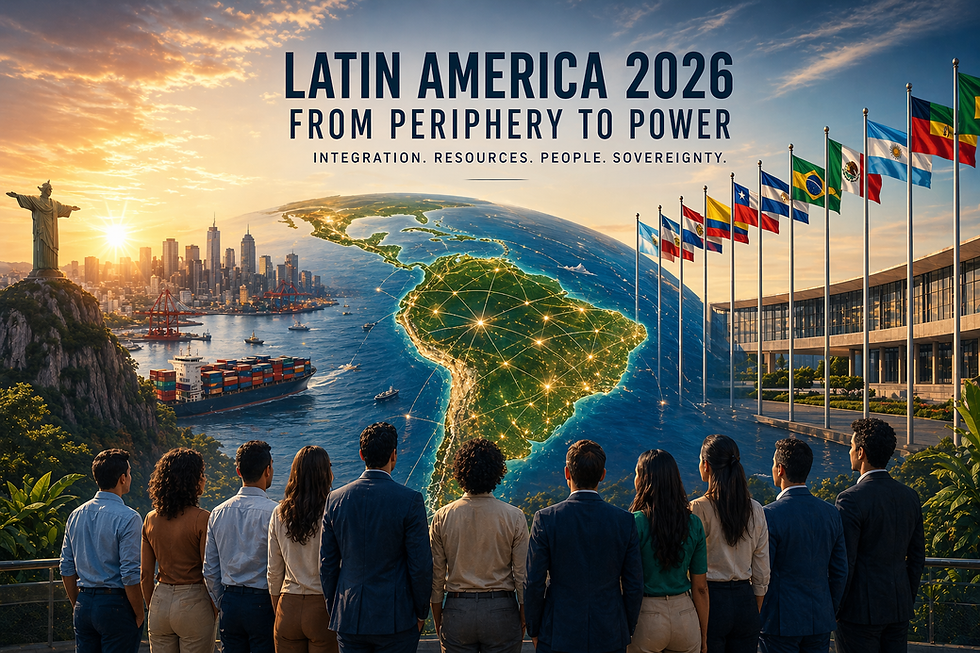
By 2026, Latin America (LatAm) is no longer a passive "backyard" but is transforming into an active geopolitical player. The aggressive foreign policy of the US under Trump's second term (an updated "Trump Corollary" to the Monroe Doctrine) and intense confrontation with China present the region with an existential choice: either fragment under external pressure or consolidate into a unified regional force. The latter scenario is becoming the most likely — LatAm is forced to build an internal political identity, deepen integration, and position itself as an independent competitor to other macro-regions of the world.
Geopolitical Imperative: From Balancing to Rapprochement
The US strategy of 2025–2026 (including operations in Venezuela and pressure on the Panama Canal) sends a clear signal: Washington will not tolerate a significant Chinese presence in the Western Hemisphere. Beijing, in turn, responds with its third Policy Paper on LatAm, emphasizing economic interdependence and "Global South" rhetoric.
Under these conditions, individual countries in the region (Mexico, Brazil, Argentina) can no longer effectively balance between the two superpowers. Forced rapprochement is manifested in:
Strengthening MERCOSUR and CELAC as platforms for collective negotiation.
Brazil's (the regional leader) active multi-alignment, focusing on BRICS while maintaining pragmatic ties with the US.
Forming common positions on critical minerals and infrastructure (lithium, copper, ports).
The result — LatAm gradually acquires a regional identity not as an object of competition, but as a subject capable of dictating terms in supply chains and resource security. Without such consolidation, the region risks becoming mere currency in a global power game.
From Economic Union to Political Union: The Latin American Path
It is crucial to note: by 2026, LATAM countries have not only realized the necessity of economic integration but have also come close to the idea of forming a supranational entity comparable to the European Union. This is not about blindly copying EU institutions, but about creating their own model — a Comunidad de Estados Latinoamericanos with elements of a common market, foreign policy coordination, and, prospectively, mutual defense mechanisms.
External pressure acts as the driver for this process. Just as the threat from the USSR pushed Europe towards unification, the US-China confrontation forces Buenos Aires, Brasília, Mexico City, and Santiago to seek support in each other. A key difference from the early EU is that the Latin American model allows for multi-speed integration and preserves room for geopolitical disagreements (e.g., regarding Cuba, Venezuela, or Russia). However, it is precisely the region's resource base and demographic weight that transform these disagreements from fatal into manageable issues.
Economic Data: The Foundation of Competitiveness
The LatAm economy in 2026 shows resilience amid global fragmentation. According to consensus forecasts (ECLAC, IMF, World Bank), regional GDP will grow by 2.1–2.3%. This is modest compared to Asia, but stable and supported by structural drivers:
Nearshoring and friendshoring: By 2025–2026, Mexico has solidified its position as the largest US trading partner ($873 billion in two-way trade in 2025). US imports of high-tech products from Mexico grew by 46%, while those from China nearly halved. Central America receives additional investments in logistics and light industry.
Critical resources: Latin America controls ~40% of global copper production and a significant share of lithium (the "Lithium Triangle" — Argentina, Bolivia, Chile). In 2025, FDI in mining and renewables exceeded $190 billion across the region. Brazil leads in capital attraction ($40+ billion annually).
Trade diversification: The MERCOSUR-EU deal (in its final stages) opens the European market for agricultural products and green energy. China remains a key buyer of soy, iron ore, and copper, but is no longer the only one.
These data show: LatAm is becoming a "safe harbor" for global supply chains — closer to the US than Asia, with lower risks than Europe or the Middle East.
Capital Relocation: A Perfect Match with European and Middle Eastern Instability
Rising geopolitical instability in Europe (the ongoing Ukrainian conflict and energy risks) and the Middle East (regional escalations) creates a powerful push factor for global capital. Investors from the EU, the Middle East, and Asia are seeking diversification into stable emerging markets with a resource base and demographic dividend.
LatAm fits this profile ideally:
European and Middle Eastern funds are actively entering renewables (solar and wind energy in Brazil, Chile, Colombia).
Corporate relocation: European companies are moving production to Mexico and Central America to mitigate risks.
FDI in 2025–2026 remains selective but concentrated in strategic sectors — precisely where the region offers higher long-term returns than volatile markets in the Old World.
Estimates show the share of capital from Europe and the Middle East in LatAm's energy and mining sectors grew significantly in 2025. This is not accidental — it is a structural shift in global asset allocation.
Migration as a Catalyst for Integration: A New Wave from the EU, US, and Canada
Alongside capital, migration flows into LatAm are intensifying, and their composition is changing qualitatively. US border tightening policies have led to "reverse migration" — thousands of migrants (including Cubans, Venezuelans, and Central Americans) are staying in the region instead of moving north. According to IOM data, in 2025–early 2026, over 94% of surveyed Cubans in Costa Rica plan to remain in Latin America.
However, the key new trend is the relocation of human capital from the EU, US, and Canada. European engineers, IT specialists, and managers, disillusioned by the energy crisis and stagnation in Europe, as well as some progressive American intellectuals rejecting Trump's second term, are beginning to view cities in Brazil, Chile, Uruguay, and Costa Rica as new hubs. This creates a dual effect:
An influx of highly skilled personnel and entrepreneurs into Brazil, Colombia, and Argentina, accelerating technology transfer.
Growth in domestic demand and the formation of a "critical mass" for developing IT, fintech, biotech, and globally-oriented service sectors.
Unlike Europe with its demographic crisis, LatAm is gaining not just a young population but hybrid human capital — a combination of local adaptability with experience brought from North America and Europe. This enhances long-term growth potential and creates cultural-institutional preconditions for deeper integration along European lines.
A New Power on the Horizon: The Military-Political Dimension
The accumulation of resource, demographic, and technological power inevitably raises the question of the military-political dimension of consolidation. In the medium term (2030–2035), LATAM countries, even while maintaining geopolitical disagreements on specific issues (e.g., along the Mexico-Southern Cone divide), could form common collective security mechanisms — their own version of the European Common Foreign and Security Policy (CFSP). This does not imply an immediate unified army, but rather:
Coordinating positions on control over the Amazon, Antarctica, and sea lanes.
Joint exercises and weapons standardization (through the development of the existing South American Defense Council).
Using migration flows and relocants to enhance the technological base of the defense industry (cybersecurity, drones, satellite reconnaissance).
LatAm as a Competitive Regional Power
In 2026, Latin America stands on the threshold of transformation. US aggression and confrontation with China act as catalysts for internal consolidation. The region is not merely surviving — it is building a political identity, economic autonomy, and attractiveness for global capital and migration amid instability on other continents.
LATAM countries, leveraging the demographic dividend and the relocation of human capital from the EU, US, and Canada, are laying the foundation for a new economic, political, and — in the medium term — military power. For investors and businesses, this means a window of opportunity: projects in critical minerals, nearshoring, green energy, and infrastructure enjoy both geopolitical protection and fundamental demand. The main risk is insufficient integration speed, potentially hindered by historical disagreements. The main advantage is the unique combination of resources, geography, and demography in a world where security and proximity to US markets become a premium, and the Latin American path towards a "common home" proves as compelling as the European one.
In an era of policy volatility and structural capital rotation, informed positioning matters — connect with Krol and Partners for independent geopolitical and macro-market research.
Krol and Partners
Strategic insights on finance and geopolitics
Disclaimer:
This content represents the personal analytical opinion of the author and is provided for informational purposes only. It does not constitute investment advice, financial recommendations, or an offer to buy or sell any financial instruments.


Comments